Best Bail Bond Software (2026): What to Look For
There's no single "best" bail bond software. The right one depends on how you run your book, how many writers you have, whether you need national coverage, and how you want to be billed. This guide covers what actually matters when you're choosing, then gives an honest read on the real options, including where Bondr fits and where it doesn't.
Eight things that actually matter.
This is the money feature. You want the software counting down to every appearance and surfacing anything sliding toward a forfeiture, not just a calendar you have to babysit.
Reminders are table stakes. What separates tools is whether they help you triage, so the bonds most likely to cost you get worked before the deadline, not after.
Pulling a booking off the county roster instead of retyping it saves real time at intake. Depth matters, and it varies a lot by state and county.
Look closely at how payments work and who holds the money. Some tools process on their own platform and take a cut; others let you use your own processor. Also check for per-payment fees and card percentages.
Generating indemnity agreements, receipts, and bond summaries is standard. Remote e-signature is common but not universal, so confirm it if you need it.
If you rely on GPS check-ins or national re-arrest alerts, verify they're included and how they're priced, because these are frequently metered.
The base price is only half the story. Watch for per-text, per-payment, per-defendant, and per-document fees, plus monthly caps. On a busy book, a low sticker with heavy metering can cost more than a higher flat price.
Understand who can see your book, where your data lives, and that you can export it. And decide whether you need native iOS/Android apps today or whether a browser-based app on your phone is enough.
An honest read on each.
Pricing and features are summarized from each vendor's public site and can change, so verify current details with them.
Florida-first, forfeiture-led
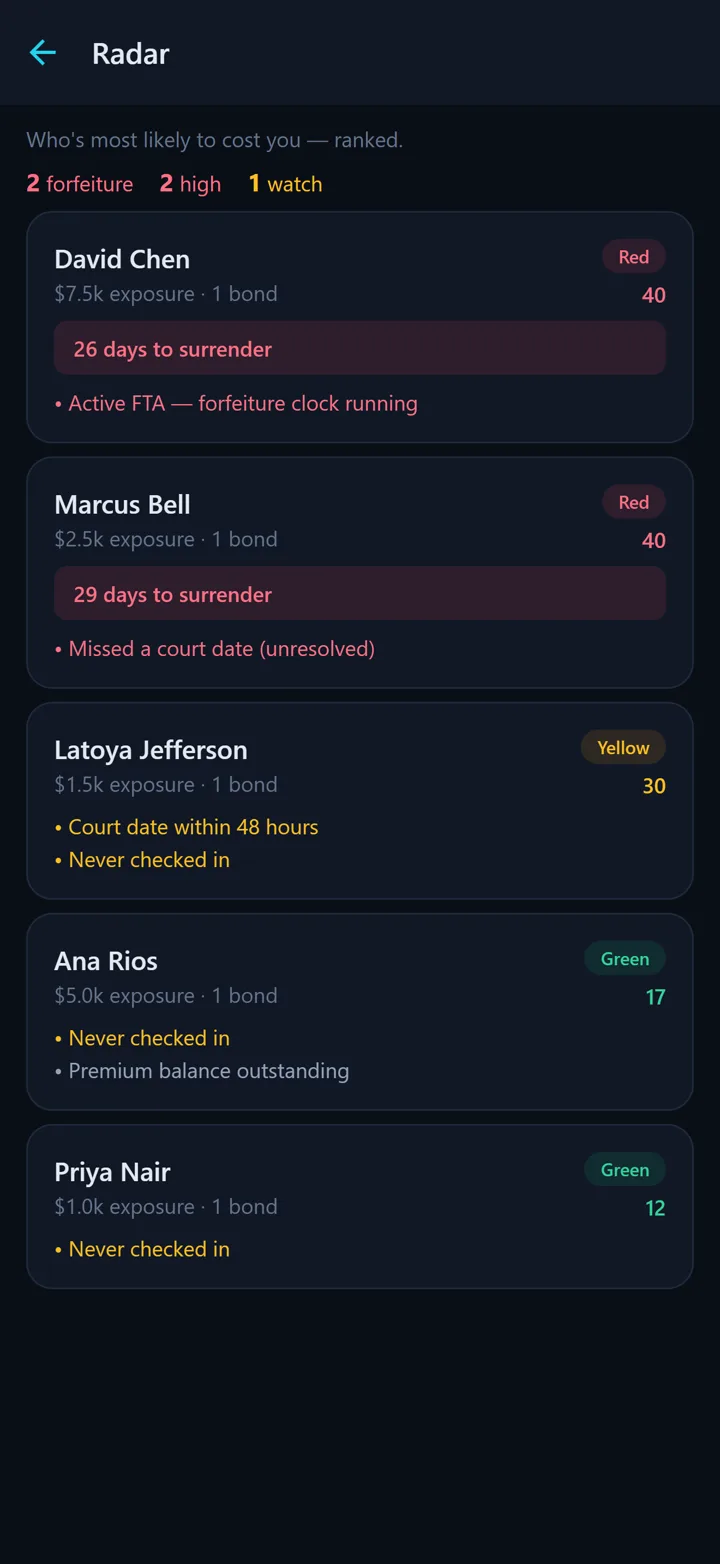
Web-based, built around forfeiture prevention. Its Radar action center ranks your active book by risk using plain rules (exposure, unpaid premium, watch status; not AI, not predictive) so the bonds most likely to cost you stay on top. Jail lookup covers 91 monitored county rosters in 17 states, 32 of them in Florida. Premium is collected into your own Stripe account, so you keep your processor and Bondr never holds your funds. AI document capture reads booking sheets and court notices for you to confirm, with nothing saved on its own. Pricing is flat per writer ($129/mo, or $159/mo for Bondr Pro, plus $59/mo per additional writer up to five), no per-text or per-payment metering. Honest gaps: no remote e-signature, no automated GPS check-ins, and no national arrest monitoring yet; it's an iPhone and iPad app but no Android app yet, and jail lookup is a named county list rather than a national feed.
Established and national
A deep feature set: included e-signature, GPS check-ins with geo-fence and facial-recognition alerts, national re-arrest alerts, and online payments. Base pricing is competitive, but several features bill by usage (texts, Defendant Watch, payment tools, card percentage), so model your real volume.
Low entry price, broad list
The lowest entry price, with shipped iOS and Android apps, e-sign packets, a client payment portal, and its own AI tools including AI phone answering. Tiers cap monthly bonds and agents, and some features (SMS alerts, payment portal) are add-ons.
Full platform + recovery app
A mobile app and a dedicated fugitive-recovery app, GPS check-ins, and court and forfeiture management. Sold in tiers with an a-la-carte data menu, so per-defendant monitoring, per-document e-sign, and data reports are metered.
Flat and low-sticker
Flat, no-metering pricing like Bondr, generally at a lower sticker, with client text notifications, customizable forms, reporting, and a mobile check-in app. A strong pick if flat pricing is your priority and you don't need Bondr's forfeiture-first workflow or Florida jail depth.
Wide arrest-alert reach
Strong on arrest-alert reach (it advertises monitoring across thousands of jails in many states) plus payment-plan automation, GPS check-ins, and e-signing. Pricing isn't public, so you'll need to contact them.
Match the tool to how you run.
Most of these offer a trial or test drive. The fastest way to know is to run your own book through two of them for a week.
Built to keep you ahead of forfeitures.
Bondr is for Florida agencies that want their software to keep them ahead of forfeitures, price flatly per writer, look up bookings across Florida counties, and collect premium into their own Stripe account.
See Bondr on your own book.
Start a 14-day trial — card required, cancel anytime before it ends and you pay nothing.