Never miss a forfeiture deadline.
A forfeiture is the one thing that can wipe out a year of premium in a single missed court date. Bondr is built around stopping it: a countdown clock on every deadline, a ranked action center that works your riskiest bonds first, and reminders you send from your own phone.
Bondr tracks every court date and forfeiture window automatically and puts your riskiest bonds at the top of the list every morning. When you enter a court date, it does the calendar math. If an appearance is missed, it starts a countdown to the forfeiture deadline — off a grace window you set to your state's number, not a generic due date — and its Radar action center ranks your active book by how much each bond could cost you. Reminders go out from your own phone, so there's no per-text fee and no auto-texting. Radar is rules-based, not AI, and shows the reason behind every score. The grace window's number is your state's, not ours — the forfeiture clock in every state, with the statute that sets it, runs from 28 days in Michigan and Alabama to two years in West Virginia.
The words behind the clock.
Plain definitions, so the rest of this page is unambiguous.
What Bondr is counting down to.
The Florida windows a forfeiture clock has to respect. Day counts vary by state and can change — always confirm with the court and county of record.
The defendant misses a required appearance. The judge forfeits the bond and issues a bench warrant (a capias).
The forfeiture becomes official and the clock the surety actually has to beat starts from this mailing.
The surety has 60 days from that mailing to pay the face amount or get the bond discharged — usually by producing the defendant. This is the window that matters most, and the one Bondr keeps in front of you.
Miss the 60 days and the court enters judgment for the full face amount. There's a further period to pay or move to set the judgment aside before an unpaid judgment starts blocking new bonds.
Even after paying, a licensed agent may surrender the defendant within two years and recover a portion — but remission is tiered and shrinks the longer the defendant is gone, net of the state's cost of return. The sooner you act, the more comes back.
Bondr's countdown reflects these real windows instead of a single generic "bond due" date. It detects the missed date from what you entered; it does not read the courthouse docket, so verify status with the court.
Your riskiest bonds, at the top, every morning.
Reminders tell you a date is coming. Radar tells you which bonds to work first — ranked by what they could actually cost you.
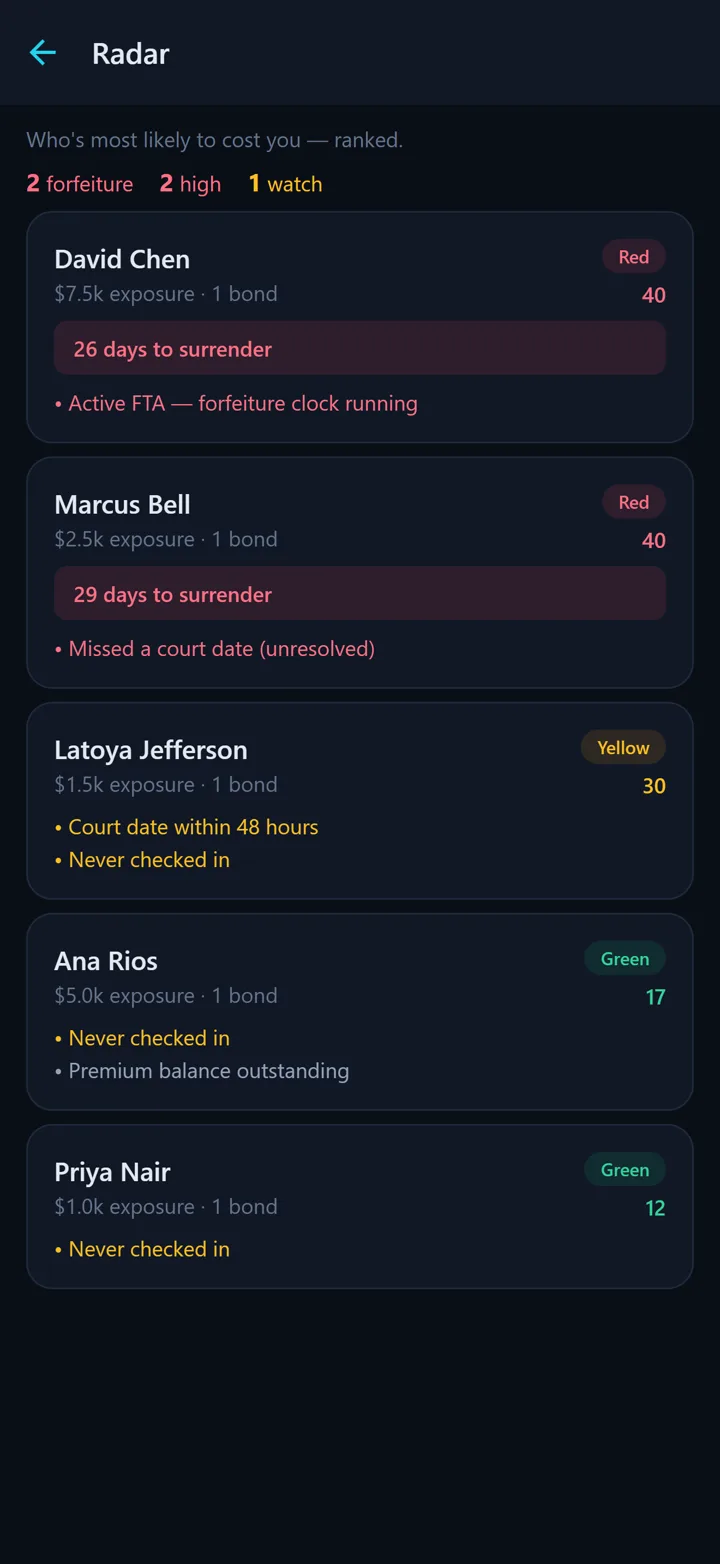
Radar is a rules-based ranking of your own data — not AI, and not a prediction. It scores every active bond by plain factors you can see: the face amount on the line, how much premium is still owed, how close the next court date is, and whether you've flagged the defendant to watch. Every score shows its reason, so there's nothing to second-guess. The point is triage: on a busy book, the bonds most likely to hurt you shouldn't be buried — they should be the first thing you see when you open the app.
Sent from your phone, not a robocaller.
When a court date is coming up, Bondr drafts the reminder and opens it in your own phone's text, email, or call app. It goes out from your number, not an automated platform. That's on purpose: it keeps you clear of automated-messaging rules, there's no per-text fee because you're using your own phone, and you decide exactly what's sent and to whom. No robocalling, no auto-texting on your behalf — just a faster way to do the outreach you'd do anyway.
Put a clock on every deadline.
Start a 14-day trial — card required, cancel anytime before it ends and you pay nothing.
Common questions.
When a defendant fails to appear, the judge forfeits the bond and the surety is liable for the full face amount unless it acts within the statutory windows. In Florida the surety has 60 days after the clerk mails the notice of forfeiture to pay or discharge the bond before the court enters judgment. It's the most expensive thing that can go wrong on a bond.
Enter a court date and Bondr does the calendar math. If an appearance is missed, it starts a countdown to the forfeiture deadline off a grace window you set yourself, and keeps it visible so nothing quietly runs out. It detects the missed date from what you entered, not the courthouse docket, so confirm status with the court.
No. Radar is a rules-based ranking of your own data, not AI and not a prediction. It scores by plain factors — exposure, unpaid premium, next court date, watch status — and shows the reason behind every score.
No. It drafts the reminder and opens it in your own phone's text, email, or call app, so it goes out from your number. No per-text fees, no auto-texting on your behalf.
Most offer court-date reminders and calendars; some track forfeitures as records. A live countdown to each forfeiture deadline plus a ranked action center is less common — that forfeiture-first workflow is what Bondr is built around.