Bail software built for Florida.
Most bail software is national and generic. Bondr is Florida-first: jail lookup across Florida county rosters, a forfeiture clock you set to Florida's 60-day pay-or-produce window, and premium handled as the state-approved filed rate — not a one-size-fits-all "10%."
Bondr is bail-bond software built for Florida agencies. It looks up bookings across 32 Florida county sheriff rosters, clocks the forfeiture deadline off a grace window you set yourself — put it on Florida's 60-day pay-or-produce window after the notice of forfeiture, ahead of judgment and the two-year surrender-and-remission window, and records premium as the state-approved filed rate rather than a generic percentage. Its Radar action center ranks your book by forfeiture risk, premium settles into your own Stripe account, and pricing is flat at $129/month per writer ($159 for Bondr Pro) with no per-text or per-defendant metering. National tools work in Florida too and add e-signature and GPS check-ins Bondr doesn't have yet.
Built for how Florida actually works.
32 Florida county jail lookups
Pull a booking off the county roster into a new file instead of retyping it. Coverage spans 32 Florida sheriff rosters. A few large metros, including Pinellas and Hillsborough, are manual or human-assisted rather than fully automatic, because those systems block automated access. Always verify with the county and court of record.
Florida forfeiture windows
Bondr's forfeiture clock counts down a grace window you set yourself — put it on Florida's 60-day pay-or-produce window after the clerk mails the notice of forfeiture — not a generic "bond due" date. Judgment, the set-aside period and the two-year surrender-and-remission window are Florida law you work to; Bondr clocks the deadline you configure rather than shipping a per-state rules table. The number itself is state law, not a product setting: our state-by-state table of premium rules and forfeiture clocks gives the window and the statute it comes from for 39 states.
The state-approved filed rate
Premium in Florida is the filed rate the agent charges (about 10% of the face amount, with a minimum) — a rate approved by the state, not a statutory percentage you can discount. Bondr records premium as earned, non-refundable revenue and keeps collateral on a separate ledger that returns to the indemnitor on release.
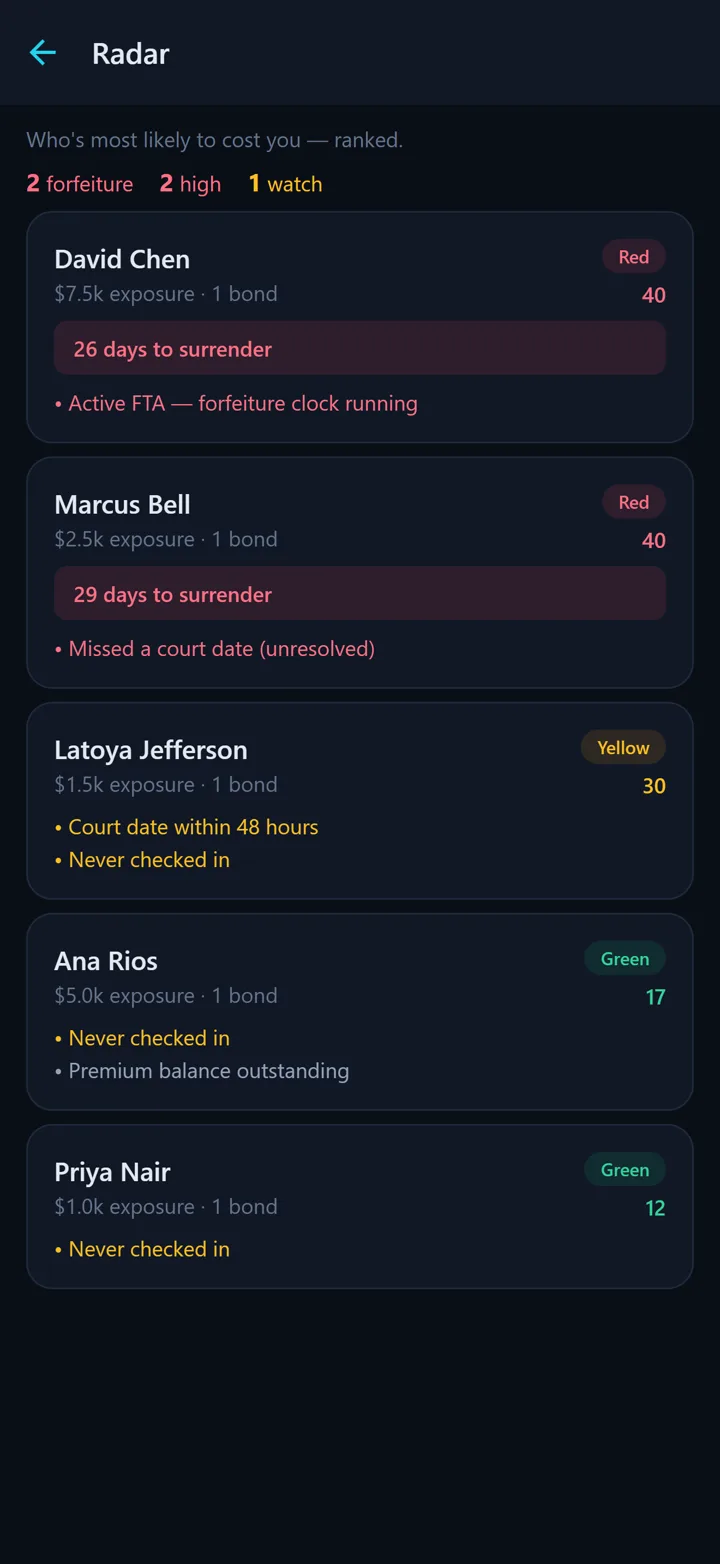
Forfeiture Radar
A rules-based action center that ranks your active book by how much each bond could cost you — exposure, unpaid premium, next court date, watch status — so your riskiest bonds stay on top. Not AI, not a prediction; every score shows its reason.
Everything a Florida shop runs, in one place.
Bondr runs your whole book — defendants, bonds, indemnitors (co-signers), collateral, premiums, court dates, and payments — in one secure account that opens in any web browser, plus a native iPhone and iPad app on the App Store. An Android app is in preparation. Beyond the Florida-specific pieces above, you get human-in-the-loop AI document capture (drop in a booking sheet or court notice and Bondr reads it to pre-fill a file, you confirm every field), one-click paperwork, a weekly surety production report, team seats for your writers, and CSV import and export so your data is always yours.
Pricing is flat per writer — $129/month for the first writer ($159 on Bondr Pro), plus $59/month per additional writer up to five — with AI document capture included and no per-text, per-payment, or per-defendant metering. On a busy Florida book, a predictable flat number beats a low sticker with usage fees.
Where a national tool might fit you better.
Bondr isn't the right answer for everyone. If you need remote e-signature, automated GPS check-ins, or national re-arrest monitoring today, Bondr doesn't have those yet — Captira, eBail, and Simply Bail do. If you write bonds across several states and need automatic jail lookup everywhere, a national tool fits better right now, because Bondr's automatic lookup is Florida-first. And if your only priority is the lowest flat sticker, Bailtec is cheaper. Where Bondr wins is a Florida agency that wants forfeiture prevention front and center, flat and predictable pricing, deep Florida county lookup, and premium collected into its own Stripe account.
Run your Florida book on Bondr.
Start a 14-day trial — card required, cancel anytime before it ends and you pay nothing.
Common questions.
Software built for Florida specifically. Bondr does jail lookup across 32 Florida rosters, clocks forfeiture off a grace window you set to Florida's 60 days, and treats premium as the state-approved filed rate. National tools like Captira and eBail also work in Florida and add e-signature and GPS check-ins; the pick depends on whether Florida depth and flat pricing or a broader feature set matters more.
32 county sheriff rosters. A few large metros (Pinellas, Hillsborough) are manual or human-assisted, not fully automatic, because those systems block automated access. Verify custody and charges with the county and court of record.
Yes — it treats premium as the state-approved filed rate (about 10% of the face, with a minimum), not a "statutory 10%," and records it as earned, non-refundable revenue kept separate from collateral.
It's Florida-first today. The engine is state-agnostic and the forfeiture countdown runs off one grace window you set yourself, but automatic county jail lookup outside Florida isn't live yet. Florida shops are the best fit right now.