Know what you earned, and what you're owed.
Premium is your income. Collateral is money you're holding. Balances are what's still coming. Mix them up and your books get messy fast — so Bondr keeps each one exactly where it belongs, on every bond.
Bondr tracks premium on every bond as earned, non-refundable revenue, keeps collateral on a separate ledger, and shows a running balance as payments come in. Payments are collected into your own Stripe account, so what's paid and what's still owed stays current without Bondr ever holding your money. For commission, Bondr records premium per bond and reports production per writer — the basis most agencies use to figure what each agent earned. It shows that production; the actual split or paycheck is handled in your accounting. Pricing is flat per writer with no per-payment fees.
Premium, collateral, balance, production.
Premium as earned revenue
The fee you charge to write the bond, recorded as earned, non-refundable income — in Florida, the state-approved filed rate, not a discountable percentage. Every bond shows the premium charged so your income is never guessed.
Collateral, kept separate
Cash or property pledged to secure the bond sits on its own ledger — not counted as income — and is returned to the indemnitor when the court releases the bond. No accidental mixing with premium.
A running balance per bond
Premium charged, amount collected, balance remaining — updated as you record each payment. Collect through Bondr and it settles into your own Stripe account and posts against the balance, so the number is always current.
Production per writer
Premium is recorded per bond and per writer, so you can see who wrote what — the basis most agencies use to calculate commission. Bondr reports the production; the split or paycheck stays in your accounting.
Clean books, and money that's actually yours.
The most common bookkeeping mistake in a bail office is treating everything that comes in as income. Premium is revenue you keep; collateral is money or property you're holding and expected to give back. Bondr keeps them on separate ledgers so your earned revenue is real and your collateral obligations are never quietly counted as profit. When a court releases a bond, the collateral is there to return, tracked to the indemnitor it came from.
On the money side, Bondr never sits in the middle of your funds. Premium and balances are collected into your own Stripe account, so you keep your processor and your rates, and Bondr takes no percentage of anything you collect. It sends only an anonymous reference to the processor — never your client's name or case details. And because Bondr's price is a flat monthly amount per writer with no per-payment fees, running more payments never costs you more in software.
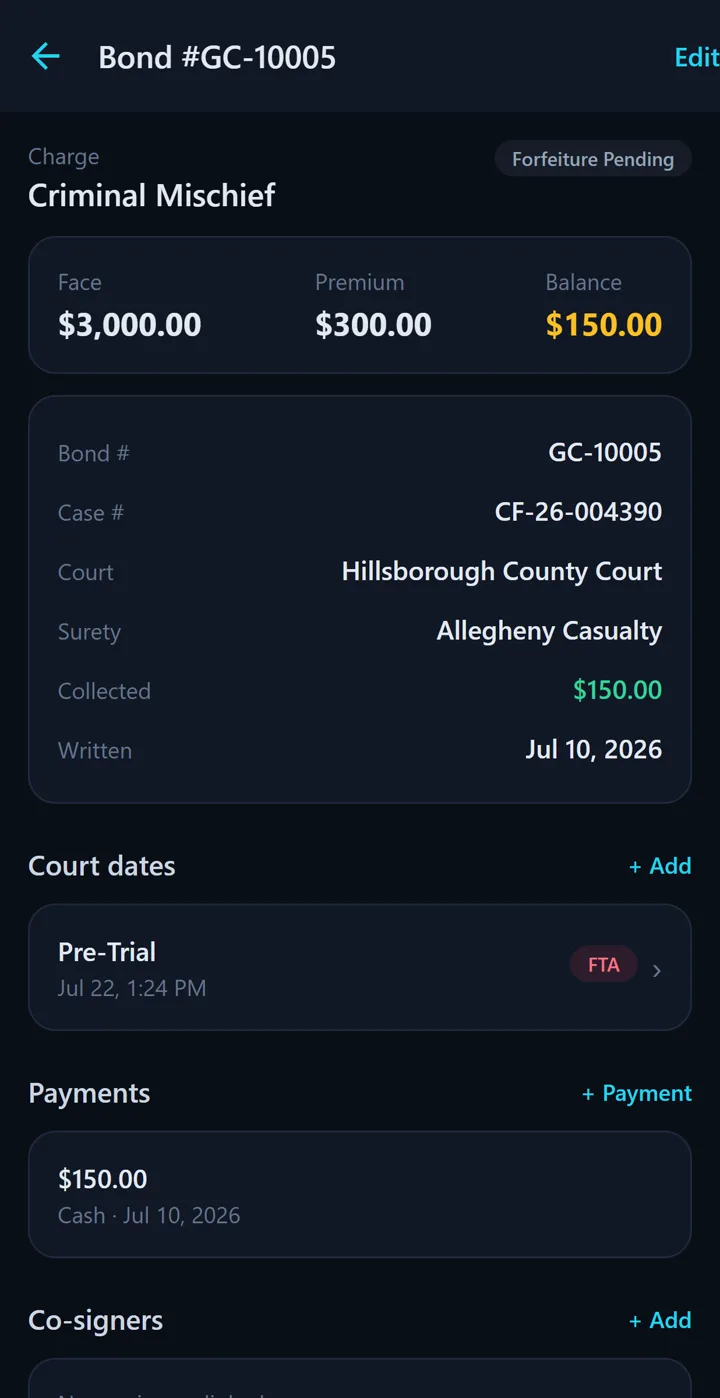
What Bondr is, and isn't, on money.
Bondr is a system of record for premium, collateral, payments, and balances, and a way to collect into your own processor. It reports production per writer as your commission basis, but it is not a payroll product that cuts checks or splits commission automatically — that final step lives in your accounting. It records what's paid and what's owed, but it is not a structured payment-plan or customer-portal tool. Most bail CRMs, including Captira, eBail, and BailBooks, also track premium and balances; they differ mainly on metering and on how much of the surrounding workflow is included versus sold as an add-on. Where Bondr stands out is keeping premium and collateral cleanly separated, collecting into your own Stripe account with no cut, and doing it on flat pricing.
See every bond's balance in one place.
Start a 14-day trial — card required, cancel anytime before it ends and you pay nothing.
Common questions.
Bondr records premium per bond as earned revenue, keeps collateral separate, shows a running balance, and reports production per writer — the basis most agencies use for commission. It shows the production; the split or paycheck is handled in your accounting. Captira, eBail, and BailBooks also track premium and balances; they differ on metering.
Premium is earned, non-refundable revenue. Collateral sits on a separate ledger, isn't counted as income, and is returned to the indemnitor when the court releases the bond. Keeping them apart avoids a common bookkeeping mistake.
Yes — premium charged, collected, and remaining balance, updated as you record payments. Payments collected through Bondr settle into your own Stripe account and post against the balance. It records what's paid and owed; it isn't a structured payment-plan product.
No. Premium settles into your own Stripe account; Bondr never holds funds or takes a percentage. Its price is a flat monthly amount per writer with no per-payment fees, and only an anonymous reference goes to the processor.